Pfc. Calvin Magoon
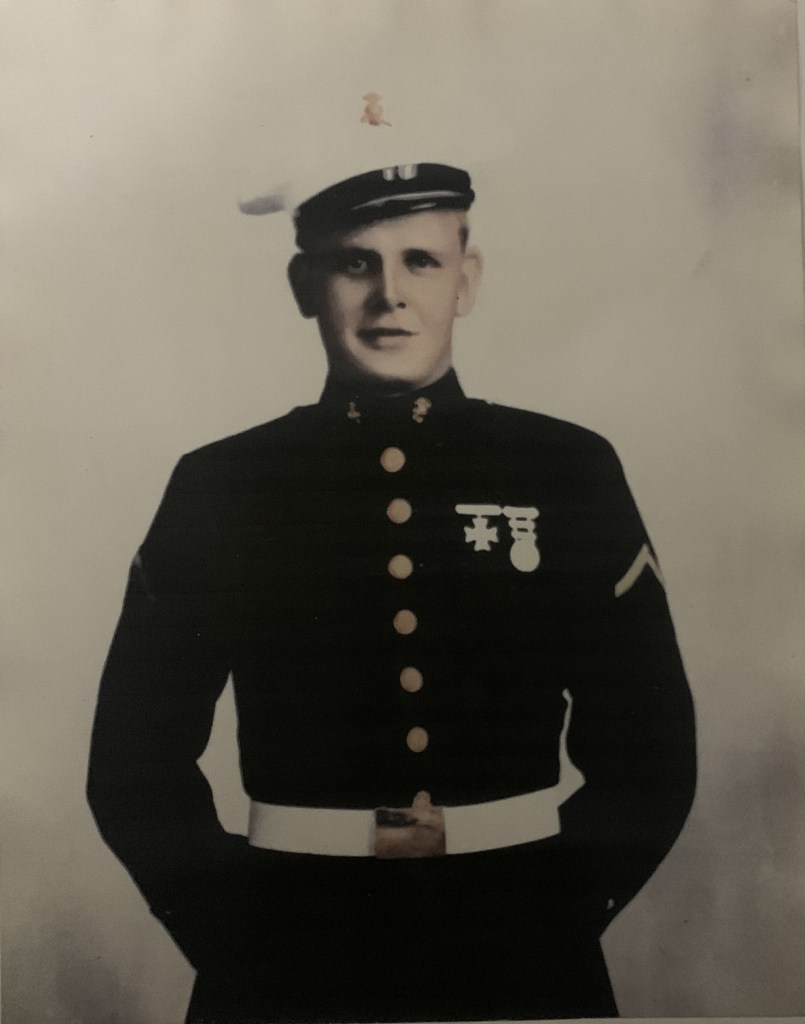
Calvin Gustav Magoon was born on July 9, 1922 in Manchester New Hampshire, the older of two sons born to Calvin E. Magoon and his German-born mother, Anna Prassler. Far from wealthy, their family still managed to live somewhat comfortably through the Depression years, renting out the first floor of a white apartment house on the southernmost corner of Conant Street, just a few blocks up the street from Manchester West High School.
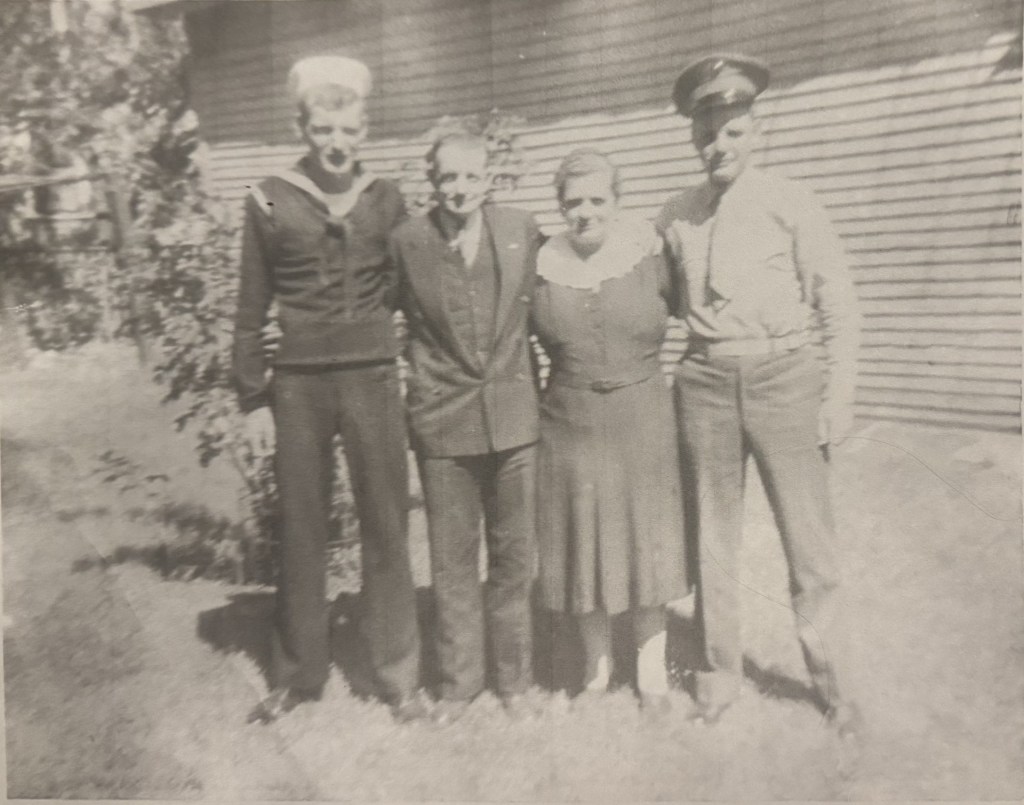
Large in stature with a ever-present warm grin, he inherited some extremely blonde hair, earning him the nickname of “Whitey” around the house (even today, his family still fondly refers to him as “Uncle Whitey”). In school, the outgoing young teenager dropped the moniker, preferring to go by the more casual “Cal” with his friends. In summers he loved to swim at the local lakes and worked as a camp counselor, but he was always a constant presence at the Bedford Grove, Manchester’s roller rink and popular hangout spot.
At one point he hit a growth spurt and grew to be nearly six feet tall. He was also blessed with an exceptionally stocky build of 168 pounds to go with it. Such size was rare for a high schooler, then as much as it is now, and he knew it too. In his high school yearbook, the seniors made out a “class will,” where each one bequeathed something in jest to a teacher or friend from other classes. Cal jokingly chose to go a different direction. In perhaps the only surviving writing of his own hand outside of his enlistment paperwork, he jokingly wrote, “I, Calvin Magoon, bequeath my build to Superman.”
He put his size to good use, playing for three years on the school’s football team. In his senior year he was selected as the team’s captain, and was the only senior from the team to earn a letter that year. In a photo of all the “letterman” from the various sports teams that year, Cal can be seen sitting on the front row, sporting a suit with a sweater underneath his jacket, clearly several inches taller and considerably more fully built than the rest of the boys that surrounded him.
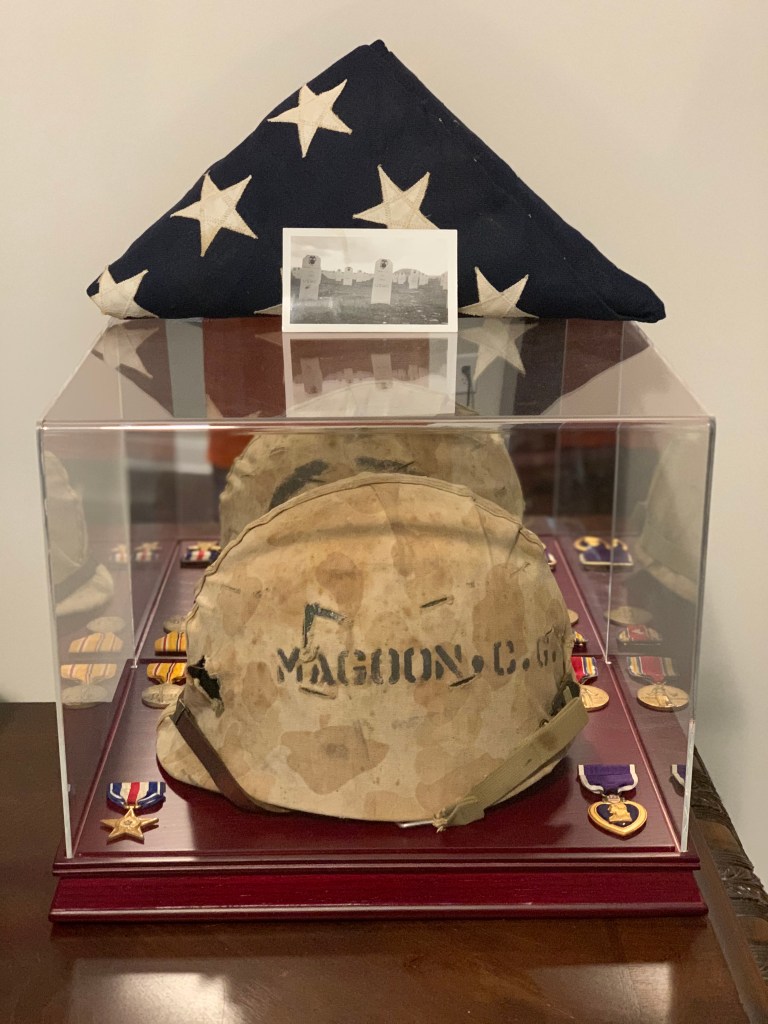
Fun-loving and happy, he was undoubtedly well-liked and a popular figure. Another favorite of his was to attend the regularly-held school or other local dances, the jazz and swing music filling the various dance halls across the country at that time. He often jokingly justified his attendance at these as more of a public service duty than anything for personal enjoyment, playing off his interest by telling his parents that since his friends were going, he had no choice but to “have to go along with them.” The obvious result of all these endeavors, combined with his stature, sporting achievements and good nature, left the fair-haired teenager with no shortage of dates on the weekends. So much so that his friend and one day sister-in-law Shirley gave a wink and a telling grin as she recalled, “he had a lot of girlfriends.”
But there was in fact one girl who was something more than the rest, someone special. And this girl happened to live in the house right behind his, the two growing up not even a stone’s throw away from one another. Their small backyards were only divided by a wooden fence, and if Cal’s timing was right, he could look out from the windows on the east side of his house and catch a glimpse of his pretty young neighbor. Roughly a year younger, Dorothy Brendle caught his eye early on and never let it go.
Genuinely sweet, funny and kind, she had a strikingly cute look about her, her cheerful smile instantly unforgettable to anyone fortunate enough to ever catch a glimpse. Although not for certain, one gets the impression that Calvin had cared and looked out for her over the years growing up, and that bond had grown into a close affection by their teenage years; the strapping, albeit goofy at times, young man continuing to keep a protective eye on her. While never quite exclusive, as was generally the norm for the day, everyone knew that the pair were meant to be. Calvin never left a record of his intentions on the matter, but there was no question in his family’s mind that the two were going to get married one day.
One Sunday in early December 1941, his family had just returned home from church when they heard the news. The Manchester community was in shock, Shirley remembered. She herself had been laying on the floor listening to the radio and “reading through the funnies” when the broadcast came through. “We were stunned,” she recalled, “it changed everything.”
The slightly-underage Magoon wanted to enlist immediately, but his parents made him wait until finished high school. The same with his younger brother Walter. Calvin dutifully waited out those last remaining months, finishing school and enlisting in the Marine Corps on June 15, 1942. Paperwork complete, he was told to report back for duty on July 1.
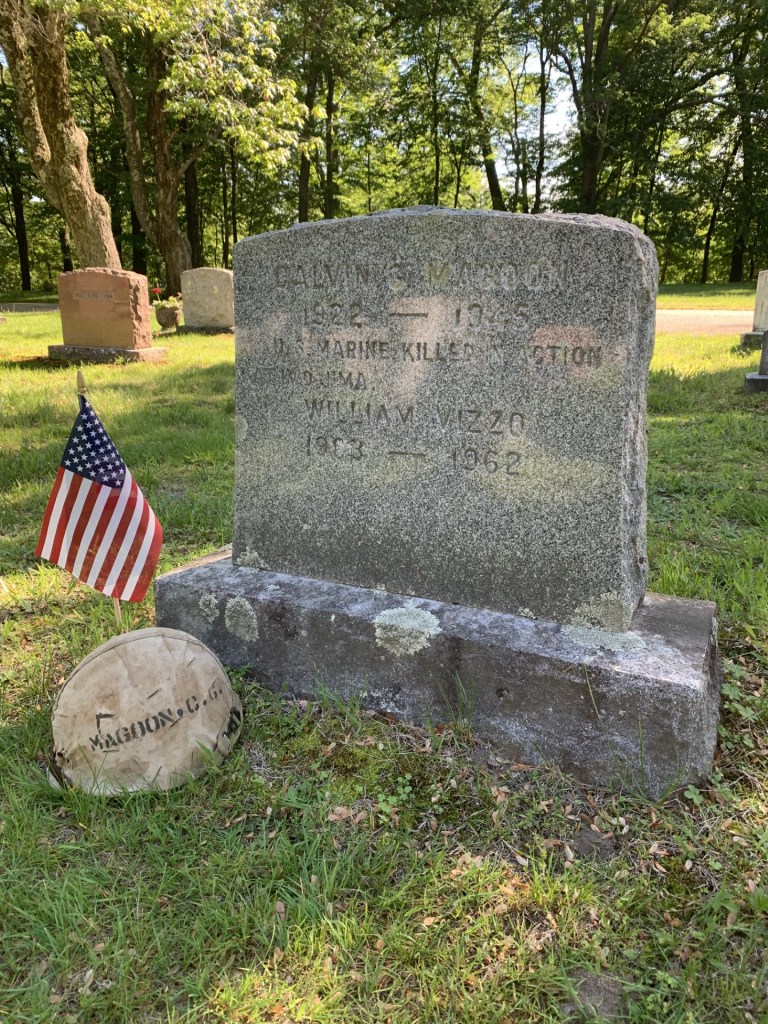
No doubt thanks to his larger stature, he was selected after Boot Camp for duty as a prison guard, serving at the Portsmouth Naval Prison until Summer 1944. The large grey prison building eerily stood on the southeast end of Seavey’s Island, located on the Maine side of the Piscataqua River, and with his home state of New Hampshire just yards away, the assignment not only spared him from the hazards of combat duty overseas, it also meant he could easily get back home whenever he was given liberty.
There was one problem with that however: this was the exact opposite of what he wanted. “I have a kid brother in Europe,” he once told Shirley, “I didn’t join the Marines to be here.”
His command however felt otherwise, refusing any requests to let him go from stateside duty. Finally Magoon had had enough. Seeing no other way to get assigned to combat duty, he took his motorcycle and raced it up and down a beach nearby until he was stopped by the police and arrested.
This proved enough to get his message through. While he was not reduced in rank or otherwise penalized for the act, he got his wish, arriving at the 5th Replacement Draft in New River North Carolina on the 4th of July, 1944. “I knew what I was doing ma,” he told his mother in his distinct New England accent, “don’t you worry about it.”
A few months later, he was in Hawaii, finding himself assigned as a replacement in K Company, 3rd Battalion, 25th Marines, an outfit that had recently distinguished itself in combat the Marianas. It took the sergeants there about half a second to note his size and then hand him the large Browning Automatic Rifle, sending him off to join 1st Platoon as it began its preparations for Iwo Jima.
 HOME
HOME 