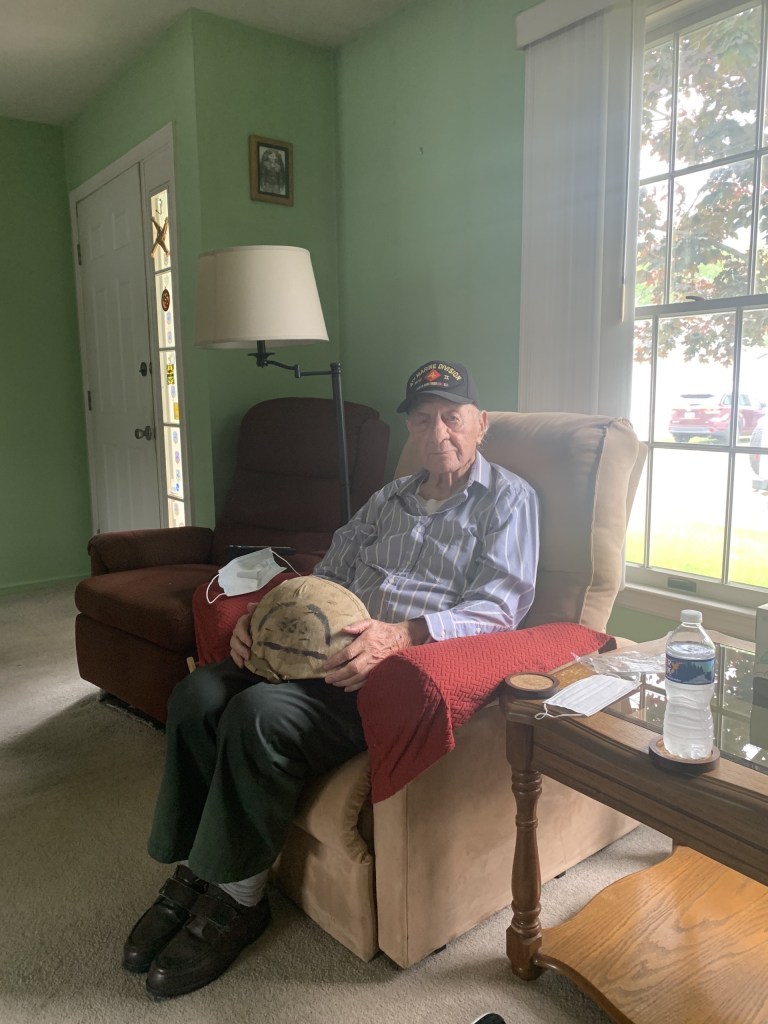
Pfc. James Hogan

Born in Hell’s Kitchen in upper-west Manhattan in September 1921, James Hogan was the youngest of four. His family moved just north of Brooklyn while he was in grade school, where the young Jim remembered playing as a boy in the “shadows” of the 59th Street Bridge. He likewise had to find ways to keep himself entertained, but quite the character from an early age, this often resulted in activities of more questionable enterprise.
In one of his earliest memories, he and his brother were playing with some World War I-era surplus ammunition that had somehow made its way into the boys’ hands. Trying to convert the ordinance into a sort of pencil-type device that they could sell to other kids in school, his brother decided to test one of the rounds out in his cork gun. Somehow the live bullet worked in the toy gun, no doubt thanks to the far from disciplined removal of all gunpowder in the casing by the two craftsmen. With a loud and unexpected pop, the brass casing was blasted out the back of the toy gun, missing his brother but striking Jim, who was observing the endeavor from over his shoulder, hitting him square in the forehead.

Before they had fully realized what had happened, blood began to gushing from the cut between his eyes, sending the two wide-eyed boys home in a panic for help. Fortunately, after only a few stitches all was well, and surprisingly, no memory survives of either of them getting into any trouble for what they had done: the nonchalant use of the phrase “boys will be boys” with a shrug was the general family consensus on the incident. Jim always recounted the story with a laugh, claiming it gave him the title of “having been shot in both world wars.”
Hogan’s father was a plumber by trade, where the common practice in the days before Teflon tape was to lick the ends of the various metal pipes prior to installation to help create a better seal. Most likely the result, his father passed away young from nephritis when Jim was only eleven. The family then moved in with his mother’s parents in North Bergen, New Jersey, directly across the Hudson River from Manhattan. With the assistance of his grandparents, they managed to get by, his mother eventually marrying a neighbor from across the street. His new stepfather had a son of his own, but Jim remembered he fully treated the two Hogan boys as his own. Seeing many around him in similar circumstances who were far less fortunate in this regard, Jim considered himself “super lucky” for the hand he had been dealt.

While perhaps not as poor as others, their lifestyle still was far from lavish in those years. Another of his earliest memories was when he received a new pair of full-length pants, the first set that he could remember, with everything else so outgrown they appeared more to be three-quarter length knickers. Within a day he was out playing stickball with the neighborhood kids and ripped them. He never fully let on exactly what his mother’s response had been, but his mother’s wrath had been so severe that he never forgot the incident. Still, he managed to survive the early ordeal, his mother sewing them back up and the pair all he had for quite some time.
After graduating from St. Jude’s Grammar School, Jim attended the “Franklin School,” named after the American Founding Father. There was a problem with this choice however, as the school was roughly two miles away from their home. This meant that if he missed the bus or it ran late in the morning, as was quite often the case with the former, Jim’s teachers would make him stay late after school, causing him to miss the afternoon routes and thus forcing him to walk the entire way home. It did not take long for the young teenager to decide school was not for him, so he convinced his parents to modify his birth certificate to make him two years older and then promptly dropped out in the ninth grade.
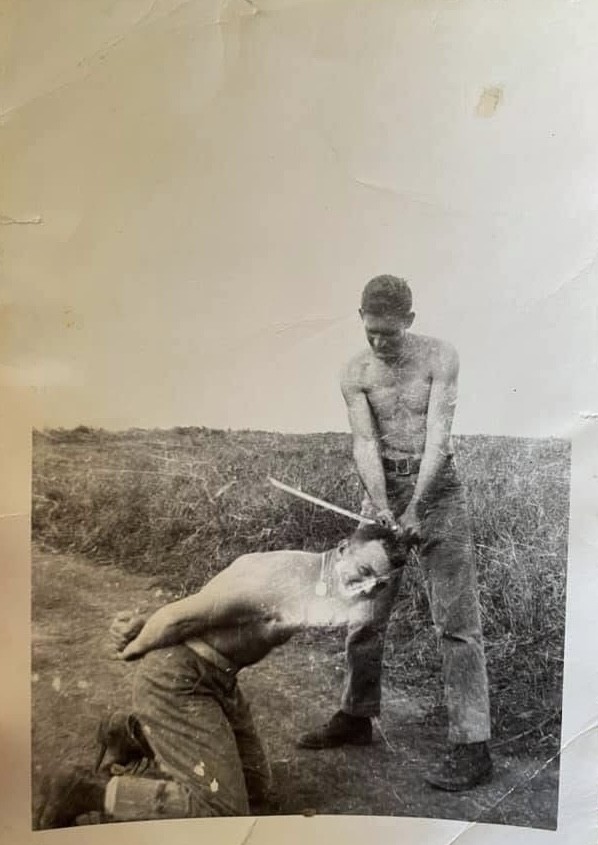
An adult on paper, albeit clearly not in appearance, he went over and signed up to join the Civilian Conservation Corps, who generally had work available. Shipping off a short time later, the Corps sent him across the country to Nevada, where it put him to work in dam construction, along with a handful of other projects that were ongoing in the region. Most of his money it provided he sent home to help the family, but Jim loved the work and the outdoors, staying on for several years before returning home at about the same time he would have graduated high school. The world was to have other plans for him as soon as he got back.
Returning home two years later, the news of Pearl Harbor soon came across the airwaves. Hogan went and reported in to his induction board not far away in Newark. After all the physicals and other examinations he was shocked to see his paperwork stamped with “4F” on top of it – not qualified for military service. When he asked why, the medical staff told him that they had found a congenital hernia in his abdomen. Hogan replied that it had never bothered him his entire life, to include in the recent years of heavy physical labor out West, but the medical screeners told him the ruptured internal lining would not hold up to the rigors he was about to endure in combat and sent him on his way.
There could be no worse embarrassment for a young man at the time; to many it was looked down on and considered shameful. And it was not even unheard of to hear of a 4F having committed suicide because of the rejection, the thought of not serving such a disgrace that American youth just could not endure living with it. “All my friends were going in the service, all going away, the Navy, the Army, everything else,” Hogan remembered of his fate. But unwilling to accept it, he went to Christ Hospital in Jersey City and had the hernia surgically repaired. The hospital bill came to $400 dollars, and to cover it, he had to completely drain his savings. “I spent all my money,” he recalled, every penny of it hard-earned through years of physical labor conducted away from home in the remote work camps.
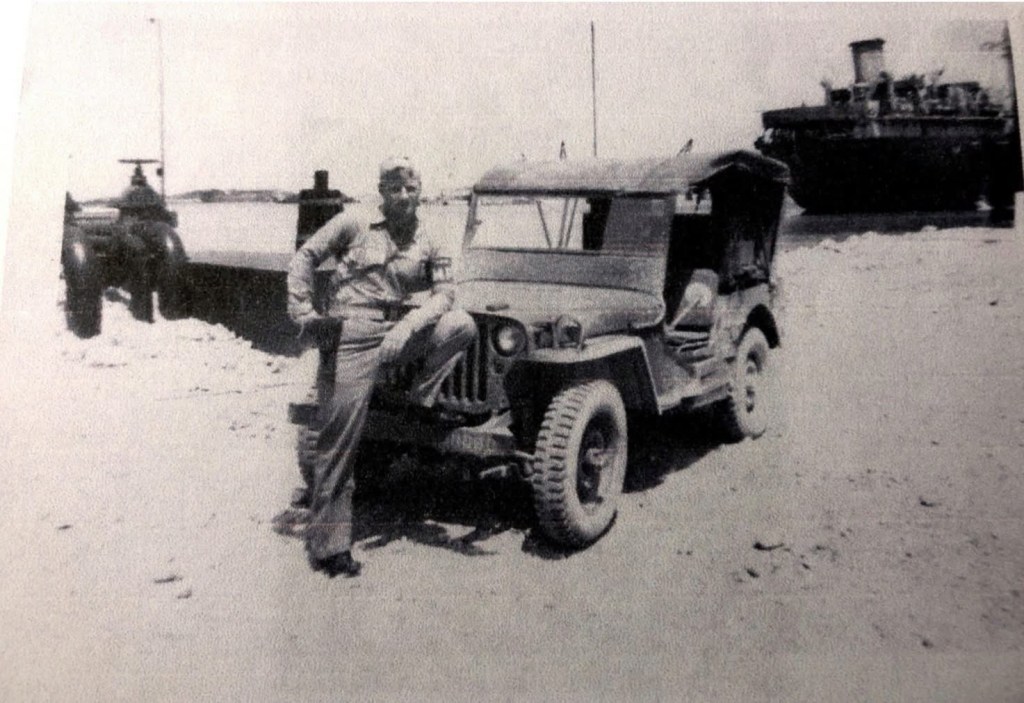
After a few months of rest, he called the board and told him what he had done. “They said, ‘you got operated on?!’ like I was crazy you know.” In disbelief, the screeners told him to come back to Newark and try the physical exams once again. This time Hogan passed without issue, the induction personnel now asking him which service he would like to join. “You read all the propaganda, and you tend to believe it,” he remembered of his decision, “so I said at this stage in the game, I might as well try and go in the Marine Corps.” This time he received no pushback from the person behind the desk, The Marines needing to fill their wartime ranks as much if not more than any of the others.
A short time later Hogan said his goodbyes and reported back in as was directed, then was put on a bus headed for an induction center on Church Street in New York City. There they officially swore him in and put him on a train bound for South Carolina and boot camp. As he sat down and the train pulled away, little did anyone riding alongside him know that the man sitting next to him had gladly just given every cent he had to be on that train; given literally everything he had so he could answer his country’s call.
His country was about to ask him to give even more.
 HOME
HOME 